

Every star needs a ladder
When psychological safety exists but people still feel stuck, the issue isn’t confidence - it’s the ladder beneath them

Over the last decade, particularly working with women, I’ve heard a version of the same story again and again.
A capable professional is told they need to be more confident. More assertive. More visible. To elevate themselves in the higher echelons.
They take it seriously. They prepare differently. They speak up more clearly in the boardroom. They challenge decisions instead of letting them pass.
And then the feedback changes.
They’re told they’ve come across as too aggressive. Too forceful. Not quite the right tone.
What’s striking isn’t the contradiction - it’s the absence of guidance in between. Nothing about the culture or environment they’re operating in. No shared language for how to challenge well. No clarity on where the line actually sits. Just the expectation that people will somehow learn it by trial and error.
This is often framed as a confidence problem.
A you problem.
It isn’t.
At work, we talk a lot about “stars”. High performers. People with potential. Those we want to see shine.
But stars don’t reach the top on their own.
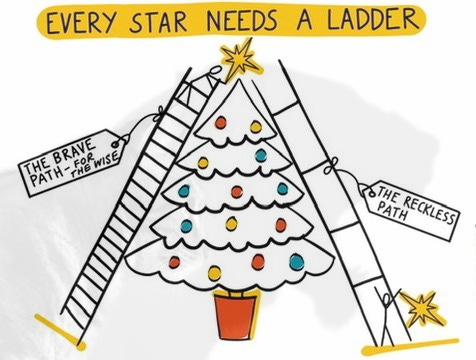
They get there via ladders - systems of support, judgement, and permission. Some ladders make brave decisions possible. Others quietly increase the risk of a fall.
Most people don’t struggle because they don’t want to step up. They struggle because they don’t know which ladder they’re standing on - or what it can safely hold.
Psychological safety has helped us name the importance of voice. It has reduced fear and invited people into the room.
But safety alone doesn’t teach people how to act once they’re there.
Reducing fear doesn’t replace the need for judgement when decisions carry risk. Without courage - and without support for how courage is meant to show up - even safe environments can slide into comfort rather than progress.
The courage we’re talking about here isn’t dramatic.
It’s the courage to calibrate.
To challenge without burning bridges.
To hold a boundary without escalating conflict.
To speak in a way that can actually be heard.
The people I work with aren’t afraid of courage. They’re afraid of misjudging the cost. Of crossing an invisible line and paying for it later. Of lessons learned and quietly observed.
Often, that fear is rational.
When I hear this story repeated - “be more confident” followed by “not like that” - I don’t hear inconsistency. I hear a system asking for courage without building the ladder that supports it.
Ladders don’t just provide access. They shape how people climb. They determine which risks are rewarded, and which are punished.
The problem isn’t that people don’t want to shine.
It’s that too many are being asked to climb without support for how to do so wisely.
I’ve explored this pattern more fully in a longer piece on my website, looking at why psychological safety alone rarely delivers growth - and why courage needs to be treated as a capability, not a personality trait.
Because stars matter.
But ladders decide what it costs to reach them.
Be Braver® Practitioner Prompts
Which ladder are you currently climbing at work - and who built it?
Where have you been asked to “be more confident” without clarity on what good judgement looks like?
What risks feel rewarded in your environment - and which feel quietly punished?
Where might you be holding back, not from fear, but from a lack of support for how to act wisely?
What would courageous calibration look like for you right now?
Keep on keeping on, stay brave


In a world defined by rapid technological change, inequity, and uncertainty, courage may be the most essential human capacity we have. Yet our systems of power still reward only the exceptional or the visible - the headline acts of bravery that fit the old myths of the god-like hero.
But the bravest among us are often those whose choices remain unseen. The daily persistence. The quiet refusals. The fragile but fierce steps that never make the news.
That is why I write, and why Be Braver exists: to make invisible courage visible, learnable, and shareable. To spark collective action. To give colleagues, carers, citizens, and leaders alike the confidence and capability to shape a fairer, more equitable, sustainable, and creative future.
Because heroism doesn’t belong to the powerful few. It belongs to all of us - whenever courage calls our name.
Quiet courage and quiet confidence for Quiet Visionaries.
Love it.
My career in agencies ended when I was hired to be assertive and help shake up a culture that had become too safe. “We know what you’re like”, he (a previous boss) said “we want you to question everything”. A year later I was paid off for doing just that. The lawyer that signed my agreement wanted me to take them to court for gender discrimination said I had a strong case and would make an excellent witness. I didn’t because I was afraid of the emotional cost and thought it would affect my future employment prospects. As it turned out I left the industry a year later anyway. But anyway, I relate thank you for all you do xx